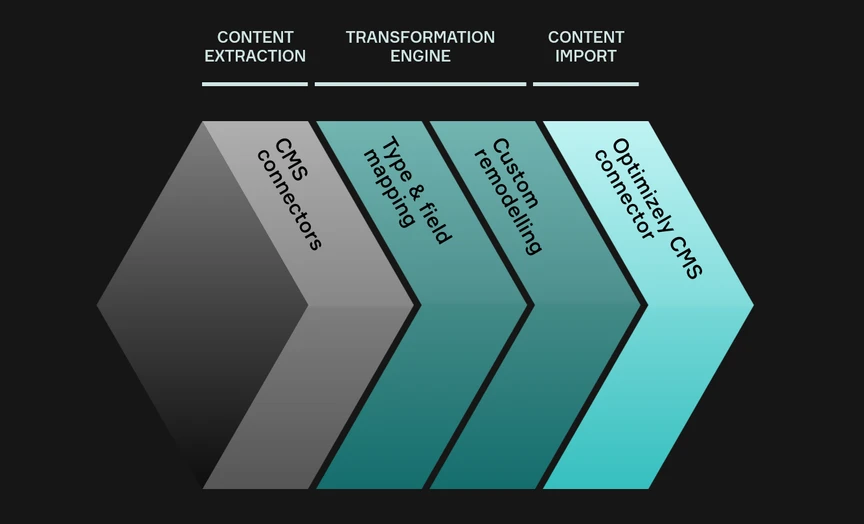
With Proxima Content Migration, we follow a proven, structured process that minimizes risk, reduces manual work, and ensures a predictable outcome. The process is iterative by design, allowing adjustments along the way without losing momentum.
1. Initiation phase
We start by establishing a clear foundation for the project.
In this phase, we align on scope, goals, and prerequisites to ensure that the migration is both feasible and efficient. We also identify any potential risks early on.
Key activities:
- Project initiation and stakeholder alignment
- Analysis of source system and export possibilities
- Definition of overall requirements and scope
- High-level timeline aligned with the web project
- Price validation
- Proof of Concept (POC) to validate approach
Outcome: A validated scope and approach, with a clear understanding of complexity and effort.
2. Preparation phase
Once the foundation is set, we move into detailed planning and technical preparation.
This phase focuses on defining exactly how content should be migrated, transformed, and structured in the new solution.
Key activities:
- Detailed project planning and timelines
- Definition of detailed requirements
- Migration and content strategies
- Content export from the source platform
- Setup of test cases and validation scenarios
Outcome: A clear migration blueprint, ready for execution.
3. Migration phase
This is where the actual migration takes place, but in a controlled and iterative way.
Instead of a one-time “big bang”, we continuously refine mappings and transformations to ensure the content fits perfectly into the new structure.
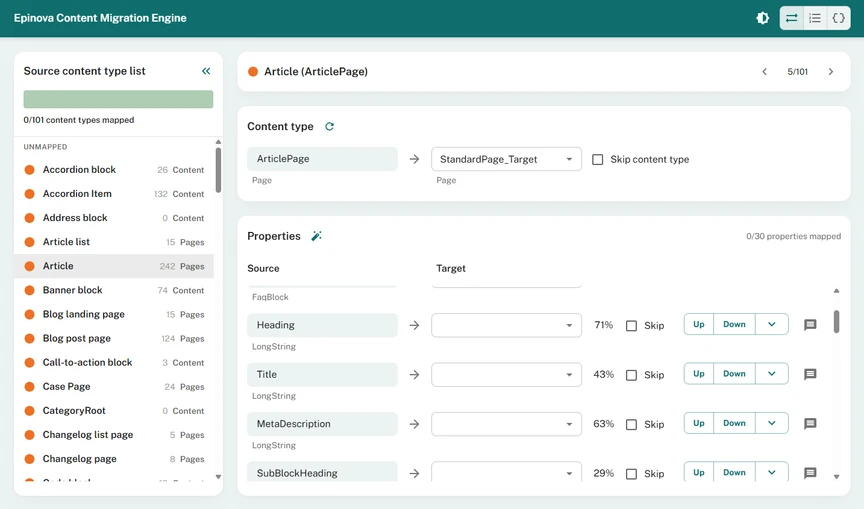
Below is a screenshot of our content mapping tool within the migration engine. This provides a clean interface to review and change mappings both for us and working with customers.
Key activities:
- Mapping of content types and fields
- Custom mappings for complex content structures
- Iterative refinement of mappings
- Import of content into the target system
Outcome: Content successfully migrated and structured in the new platform.
4. Validation phase
After migration, we ensure that everything works as intended, in the real environment.
This phase is critical to secure quality, consistency, and readiness for launch.
Key activities:
- Validation of content in real templates
- Functional and editorial testing
- Adjustments to mappings if needed
- Final handover
Outcome: Verified, high-quality content ready for editors and end users.
Built for control, speed, and flexibility
What sets Proxima Content Migration apart is not just the process itself, but how it enables iteration and control throughout the project.
You don’t have to get everything right from the start. You can test, adjust, and improve continuously, without starting over.
The result is a faster, safer migration with significantly less manual effort, and a platform that’s ready to perform from day one.