Gazing into 2026: Four digital trends emerging across clients
As we’ve wrapped up 2025 and step into 2026, I wanted to share some personal reflections on how the digital landscape around websites and digital applications is evolving and where we see our clients placing their focus right now.

1. Rapidly changing consumer discovery patterns
With the introduction of AI-generated summaries in search engines like Google, and the increased adoption of AI agents, the discovery phase is changing rapidly.
Previously, users would perform a search and click through top results to gather information themselves. Today, AI agents increasingly assist with that information gathering. Consumers still visit websites to validate or explore further, but much later in the journey, making it critical for brands to appear as trusted sources for AI agents and summaries.
Adding value-driven content such as guides, calculators, or interactive tools can be an effective way to attract users once the AI agent has handled the basic information needs.
SEO still matters, more than you might think
While AEO and GEO are new acronyms gaining attention, it’s important to understand that they still depend heavily on traditional SEO. SEO continues to drive significantly more traffic than AEO/GEO, making it essential to keep foundational SEO efforts strong while adapting to new discovery patterns.
2. Implementing AI beyond ChatGPT
While basic AI adoption has gained traction, for example through chatbots like ChatGPT, many companies are still exploring how to use AI in a broader, more systematic way.
Over the past year, we’ve worked with clients to identify concrete business value in AI-driven agents and workflows. Much of this has been done using Optimizely’s Opal AI orchestration framework, but we’ve also explored other platforms in this space, such as n8n.
AI automation can help solve challenges like:
- Monitoring competitor activity
- Understanding what customers say about your products on social media and even responding automatically
- Running automated content reviews to ensure alignment with brand and company guidelines
A pragmatic starting point beats waiting for perfection
My personal take is that the potential is significant, both in saving time by doing things faster, and in enabling things that previously weren’t feasible due to complexity, time, or budget constraints.
It’s strategically important to start experimenting, even if not every initiative delivers immediate results. Some AI use cases will pay off quickly; others won’t. But the learning itself is critical, especially given the incredible pace of development we’re seeing right now.
3. New ways of testing ideas with Vibe coding
(Vibe coding: using AI to rapidly prototype and build applications by describing intent rather than writing detailed specifications or code upfront),
If the previous trend focused on AI adoption at an organisational level, this one is about how we build and evolve digital solutions.
Vibe coding gained broader attention when Swedish company Lovable reached unicorn status (over $1B valuation) in less than a year. We’re also seeing companies like Google shift from a “write first” to a “show first” approach.
From specifications to tangible prototypes
Traditionally, new ideas required extensive specifications and manual UX/design sketches just to estimate scope, budget, and timelines. This often led to high upfront costs, and sometimes pushing ideas forward simply to justify the investment already made.
With vibe coding, you can describe what you want to build and let an AI framework generate it incrementally. This makes it possible to test visible, working prototypes early, even if they’re rough.
As an example, we recently explored a new module we believe many clients could benefit from. Within one day, from an internal workshop with a UX designer, we had a prototype ready to test and iterate on. We were even able to involve potential clients early, before any traditional development started.
This dramatically lowers the threshold for innovation and often results in smoother development later, since many details are already validated during prototyping.
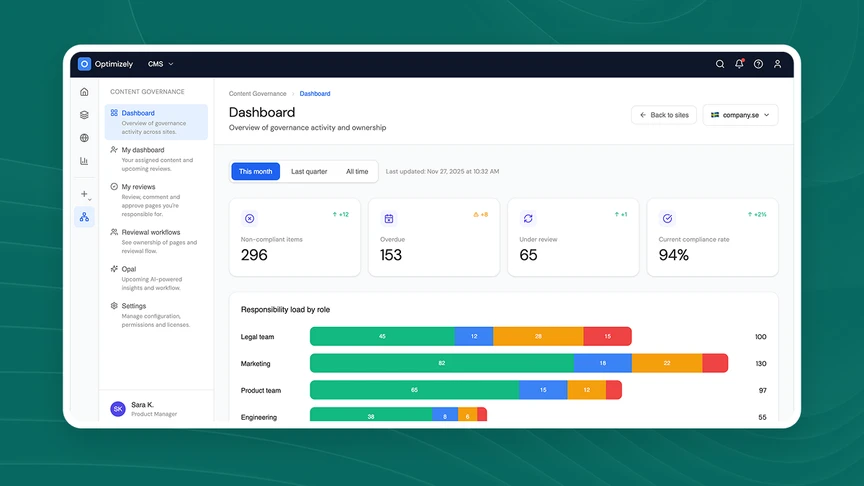
Image: shows a clickable prototype created through vibe coding.
4. System consolidation and standardisation
Many organisations have reached a point where they’re questioning the number of digital systems they maintain, often built on different platforms, or on the same platform but without meaningful synergies.
It’s easy to secure budget for a new, shiny system. It’s less exciting when most of the budget goes into maintaining multiple solutions with limited added value.
At Epinova, we’ve focused on reducing the cost and risk of consolidation. One example is our Proxima Web Accelerator, which supports multi-site and multi-brand setups out of the box. Another is our Content Migration service, which simplifies moving existing content during consolidation.
Both are built on Optimizely, a strong DXP foundation for unifying digital platforms.
Platform Engineering as a long-term lever
Platform Engineering is about solving problems once instead of reinventing the wheel. While common in product companies, it’s still underutilised in many digital organisations.
Component libraries are a well-known example, helping save time and ensure brand consistency. But there are many more patterns that require strong business ownership to realise their full value.
We’ve seen a clear, long-term trend toward consolidation among our clients — and we expect this to continue well into 2026 and beyond.
My advice to CMOs heading into 2026
- Don’t treat AI as a tool, treat it as a capability
Move beyond isolated experiments and start thinking in workflows, orchestration, and real business outcomes. - Invest in discovery, not just traffic
SEO still matters, but how people find and decide is changing. Make sure your brand shows up where AI agents look for sources. - Lower the cost of change
Consolidation, platform thinking, and standardisation aren’t just IT topics, they are prerequisites for speed, scalability, and innovation. - Test ideas earlier and more visibly
Use prototyping and vibe coding to validate direction before committing budgets, roadmaps, and organisations.
Upcoming webinar
In our upcoming webinar, we’ll dive deeper into these trends, share concrete examples from enterprise clients, and discuss how digital leaders are turning these shifts into competitive advantage.

Vi vill gärna höra vad du tycker om inlägget